
Cultural Capital for the 21st Century!
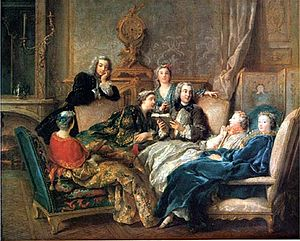
The tradition of literary salons dates back to the 18th century. From the late 1700s to the start of the 19th century, salons were an essential element of Europe’s social and cultural fabric. Despite their privileged nature—salons were typically attended exclusively by aristocrats, artists, and writers—they ushered in fundamental social and intellectual change and served as an important platform for the Bourgeoisie, the emerging upper middle class of the time. Salons established the conventions of sophisticated conversation. Philosophical concepts of the Enlightenment were debated in the Salons. Salons also provided marginalized groups like women and Jews with opportunities to exert influence on the social and cultural life of their time.
It is this progressive inclusive tradition of the Salon we want to continue at Die Hofmeisterin–on a global scale, and with the help of 21st century technology.
What Do We Read? Not Only Old White Men!
The focus will be on literary works that were part of the literary canon for many decades, in other words, the ‘classics.’ However, at Die Hofmeisterin we will not limit ourselves to works from the Weimarer Klassik (Lessing, Goethe, Schiller), but extend the term to modern classics, to works by Thomas Mann, Alfred Döblin, Anna Seghers, Ingeborg Bachmann, Walter Benjamin et al.
The goal is to make these cultural treasures accessible to all those who did not have the opportunity to encounter them as part of their secondary or post-secondary education, or who were not ready to engage with them during that time. Individuals who want to reengage with these works at a different point in their lives are also welcome.
That said, the intention behind the deep reading or re-reading of these texts is not to reestablish a cultural elite. It is rather the quest to read these works in the context of our own times; to investigate how they tackle central social questions and human conflicts: to understand them in their own historical context, but also to debate if and how they could provide a new perspective on contemporary concerns.
“I found our deep discussions about the classics inspiring. They also opened doors to other less well-known works for me.” – Nefeli B., New York City